
Navigating SOC Reports During Due Diligence


SOC reports play a critical role during transaction due diligence, particularly when evaluating service-based businesses, technology platforms, or companies that handle sensitive data. For private equity firms, these reports are indicators of operational maturity, control discipline, and potential risk exposure. Failing to properly evaluate SOC reports during diligence can lead to post-close surprises, increased remediation costs, and delays in value creation.
SOC 1 vs SOC 2 vs SOC 3: Which Report Type Matters Most in PE Transactions
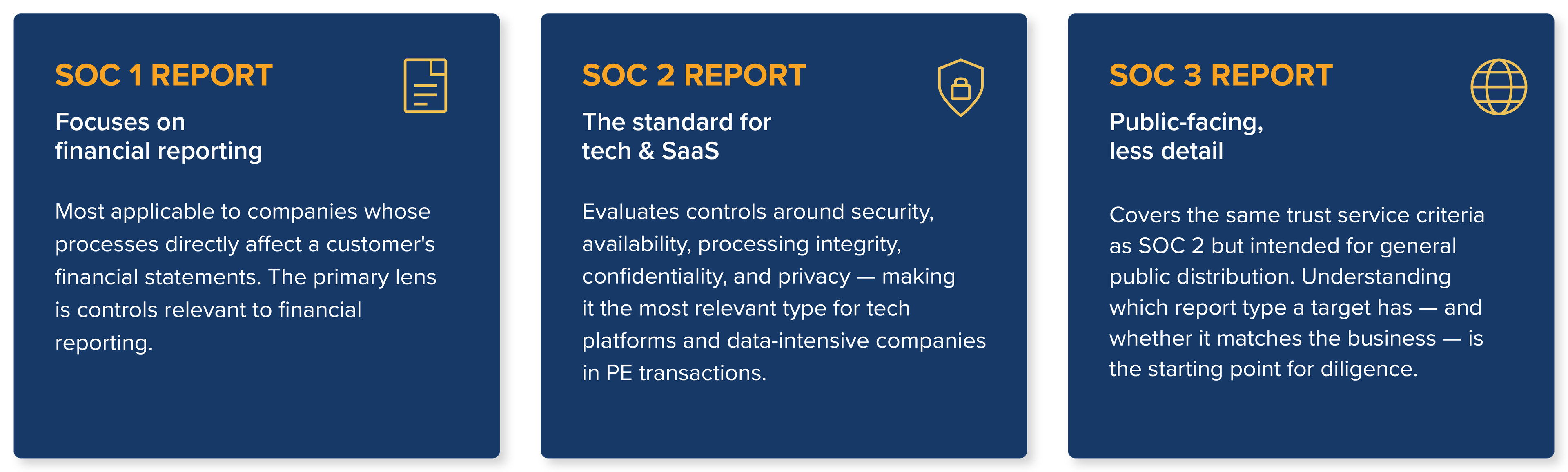
Why SOC Report Scope and Timing Matter in Private Equity Due Diligence
A SOC report is only as valuable as its scope. If the report doesn’t align with the company’s core services or systems, it may not provide meaningful assurance. In some cases, critical processes are excluded or not clearly defined. This creates gaps that aren’t immediately obvious during diligence but become more apparent after closing. A report that doesn’t reflect how the business operates will have limited value. Report timing also matters. SOC reports cover a defined period, typically 12 months, and a report that is 18 or more months old provides limited assurance about the current state of controls. During diligence, confirm that the report period is current and request a bridge letter or management representation if the report predates the transaction by more than a few months.
How to Assess SOC Control Design and Execution During Diligence
SOC reports provide insight into how controls are designed and how consistently they’re executed. During diligence, it is important to look beyond the presence of controls and understand whether they’re functioning as intended.
In many cases, control issues such as exceptions, inconsistent testing, or unclear ownership point to broader operational challenges. These findings should be viewed as indicators of potential remediation work rather than isolated issues. It is also important to review how subservice organizations are handled. Many SOC reports use a carve-out method, excluding key vendors, such as cloud infrastructure providers or payment processors, from the scope of testing. When those vendors don’t have their own SOC reports, a significant portion of the risk picture is unaddressed. For technology-driven businesses, this gap can be material.
Identifying SOC Coverage Gaps Before Closing a Transaction
SOC coverage is often incomplete during diligence, with organizations relying on outdated reports, limited testing, or no formal SOC reporting at all. These gaps don’t inevitably stop a transaction, but they do create additional work after closing. Identifying them early allows for better planning and more accurate cost expectations. In those cases, requesting a management representation letter or a SOC readiness assessment can provide interim assurance and signal whether the organization has the foundational controls in place to achieve compliance post-close. The cost and timeline of a full SOC examination, often six to twelve months and meaningful professional fees, should be factored into the deal model and 100-day plan.
How SOC Provider Quality Affects Due Diligence Outcomes
The usefulness of a SOC report is directly linked to the experience of the provider. Reports that are overly generic or lack depth often require follow-up work.
During diligence, it is worth considering whether the report reflects a thorough understanding of the business or simply meets minimum requirements. Lower-quality SOC reports can create more effort later, even if they initially appear sufficient.
Why SOC Compliance Is a Pre-Close Priority for Private Equity Firms
SOC-related findings identified during diligence rarely resolve themselves after the transaction. Early in the ownership period, organizations often need to address gaps in controls and documentation. Process issues tend to surface at the same time. Without a clear understanding of these areas, onboarding can slow down. Audits become more difficult, and stakeholder scrutiny increases. SOC compliance is also increasingly a prerequisite for other transaction-related requirements. Cyber insurers now routinely evaluate SOC 2 status as part of underwriting, and gaps in controls can result in higher premiums, coverage exclusions, or declined applications. Lenders on leveraged transactions are similarly beginning to ask about security and compliance posture.
A Smarter Approach to SOC in Due Diligence
SOC reports should be treated as a core diligence input rather than a secondary document. When evaluated thoroughly, they provide insight into how the business operates, where risks exist, and what work may be required post-close. Private equity firms that take this approach are better positioned to move quickly after closing, with a clear understanding of both risks and priorities.
Clark Schaefer Consulting works with private equity firms to evaluate SOC reports, identify gaps, and develop practical plans that support both compliance and long-term value. Our team brings deep experience across SOC 1, SOC 2, and SOC 3 engagements, and understands the pace and priorities of PE-driven transactions. We help firms move from initial report review through post-close remediation with clarity on risk, cost, and timeline. Contact our team today to see how we can support your due diligence process and post-close priorities.
Expert Contributors
Kourtney Nett
Shareholder